Pazhuvettarayar Palace
Ponniyin SelvanPazhuvettarayar Palace is a guarded residence whose gardens and subterranean treasure vault become the focus of pursuit, secret entry, and political suspicion. Its decisive significance lies in the contrast between a household that appears temporarily vacant and an interior threaded with concealed routes: the palace can shelter intruders, frustrate a search, and make its treasury a contested matter of royal trust.
Setting and Physical Layout
The palace stands within an enclosed garden, its substantial outer wall separating the grounds from the surrounding streets. After the previous night’s storm, a large uprooted tree lies broken across the wall. What the storm has damaged becomes an unplanned entrance: Ravidasan and Soman Saambavan climb the fallen trunk, cross into the garden, and disappear into its foliage. Mandhakini, who has followed them, uses the same breach to enter. The garden is therefore not merely a backdrop to their flight; its wreckage changes who can cross the palace boundary unseen.
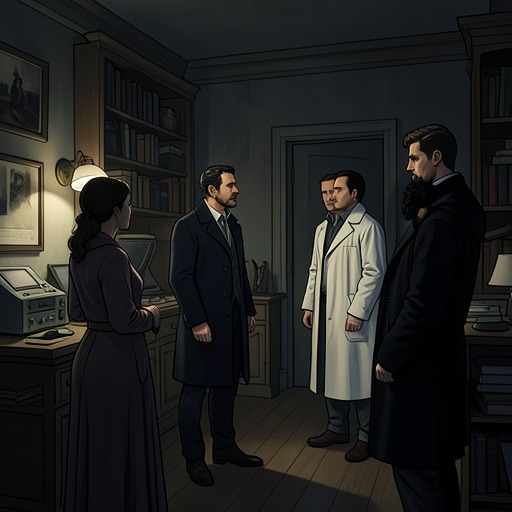
The residence appears bleak and unoccupied because both Periya Pazhuvettarayar and the Pazhuvoor Ilaiya Rani are away. Yet female attendants remain on the premises, and the gardens and buildings are not wholly deserted. The paths between the garden, mansion, and vault make the complex difficult to read at a glance: from outside, a broken wall and storm-torn grounds suggest disorder, while inside, doors, keys, and hidden access points preserve a more deliberate structure.
A spring pavilion connects the main mansion with the treasure vault. It is the same chamber in which Vallavarayan Vandhiyathevan previously met the Pazhuvoor Ilaiya Rani, so the place links an earlier audience with the later clandestine movement through the estate. The route from the pavilion leads down to the subterranean vault, whose entrance can be opened only after a sequence of keys is tried. In daylight, the unlocked doorway gives no easy access: the interior is so dark that Ravidasan must ask an attendant to bring a lamp or torch.
Intrusion and the Treasure Vault
Ravidasan approaches the palace separately from his companion, leaving Soman Saambavan at a distance while he makes contact with a maid. The attendant returns with keys and food, and the two go to the spring pavilion and the vault entrance. Ravidasan’s request for food establishes that he has gone without a meal for two days; his request for light, in turn, exposes the practical difficulty of entering the vault without attracting attention. The attendant resists the idea of fetching a lamp in broad daylight because it could provoke suspicion.
Mandhakini watches the exchange from concealment. She cannot understand Ravidasan’s words to the maid, but she recognizes that something is being arranged and keeps the men under observation. Her distance becomes consequential when she later tries to open the underground passage herself. She has followed the conspirators to the palace, but she was too far away when the access hatch was opened to learn exactly where it is; even her unusually keen eyesight cannot solve the problem. The same separation that lets her watch without being seen prevents her from retracing their entry.
The palace’s underground space is not simply a vault reached by a door. After Soman Saambavan returns carrying a torch, Mandhakini waits as his fear grows in the dark corridors. When he runs off in panic, she follows the passage beyond the staircase and discovers its other end beneath the sculpture hall. The hidden route emerges through a gap between the limbs of the Ravana Statue of Mount Kailasa in the Palace Garden. From the passage, the concealed opening is nearly impossible to detect; the monumental statue above it masks both the route and a space that could serve as a hiding place.
The sculpture hall extends the palace’s hidden geography into an elaborate stone landscape. Mandhakini recognizes figures including Sibi Chakravarthy, Shiva with the River Ganga flowing through his hair, Bhageeradhan, and the sage Agasthiyar. In the sculpted sequence, Agasthiyar pours water from a vessel, and the small stream grows into the Kaveri River, passing rocky terrain, wooded areas, and shrines before reaching a wall at the sea. The hall’s sculptural world is thus both a display of sacred and legendary scenes and the carefully concealed endpoint of a real passage beneath the palace.
Surveillance, Access, and Accusation
The palace’s ownership makes its security a political problem. Chinna Pazhuvettarayar tells Sundara Chozhar that he had kept the mansion under surveillance after hearing that a man described as a magician visited it frequently. His account says that a spy saw someone climb over the rear wall and that guards captured an intruder in the garden, whom he identified as Azhwarkkadiyaan. Chinna also complains that the prisoner invoked the Chief Minister’s authority but would not explain his presence. His speech presents the incident as evidence that the king’s city cannot be secured if the Chief Minister’s agents act without accounting for themselves.
Azhwarkkadiyaan later tells Aniruddha Brahmaraayar that he followed Mandhakini into the lane and onward to the palace, climbing the wall to search for her before the guards surrounded him. His account gives the entry a different immediate purpose from the suspicious infiltration alleged by Chinna: he was pursuing Mandhakini. The palace’s wall thus becomes the point at which an unofficial search, the city’s security forces, and a dispute between powerful officials meet. The disagreement over what the intrusion proves remains unresolved in these events.
Aniruddha Brahmaraayar says that he has no jurisdiction to order an official search of the palace, even though Mandhakini has entered it. He considers placing sentries around the grounds and alerting a spy inside the residence. His concern is sharpened by the building’s exceptional status: the palace is not an ordinary house that he can simply search through his own authority. The concealed passage and the limits on access make it possible for an investigation to stall precisely where the evidence may lie.
The Palace as a Political Fault Line
The treasure vault turns the palace from a private residence into a focus of debate about the kingdom’s resources and the credibility of its guardians. Aniruddha Brahmaraayar tells Sundara Chozhar that the men visiting the lady are not magicians but may be conspirators, and that the treasury may be steadily drained through their schemes. He proposes a thorough investigation of the palace and its underground vault. This is an allegation and a proposed inquiry, not confirmation that the treasury has been robbed.
Sundara Chozhar rejects the proposal as deeply offensive because of his long friendship with Periya Pazhuvettarayar and the service that lord has rendered to successive Chola rulers. The king’s response shows how personal loyalty can obstruct a search even when suspicion has been raised. Aniruddha Brahmaraayar, for his part, distinguishes suspicion of the palace from an accusation that its lord knowingly supports the conspiracy: he argues that the residence may be serving as a headquarters for those plotting against the Chola kingdom, and that the Pazhuvoor Ilaiya Rani may be involved.
The palace’s narrative importance comes from this double character. It is a defended family home, a treasury, a meeting place, and a maze whose secret passage can hide movement from those who believe they control the grounds. The storm opens a breach in its wall; the underground route offers concealment; and the controversy over searching the vault turns architecture into a question of political authority. Within the estate, hidden access is a physical fact. Beyond it, what that fact means remains a matter of suspicion, loyalty, and contested proof.